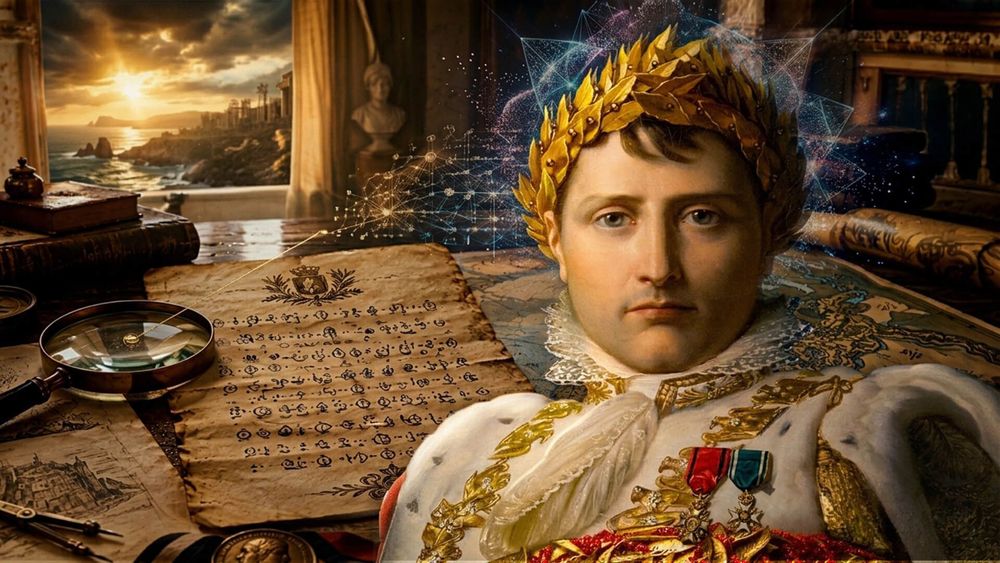
For 217 years, an encrypted message to Napoleon’s general sat shrouded in mystery.
Enter GPT-6 Astra. One low-res scan. One prompt.
In just six hours—less than a single workday—the AI transcribed 1,300 custom hand-drawn symbols, wrote its own cryptanalysis code, and broke a two-century-old Napoleonic cipher.
The breakthrough restored a lost chapter to the history books. But it also rewrote a rule about our own future:
The line between human intuition and machine capability didn't just blur. It moved.
Explore the Decoded Dispatch →
For 217 years, an encrypted message sent from Napoleon’s headquarters sat unread in the archives.
Generations of cryptographers couldn't crack it. GPT-6 Astra did it in 6 hours.
Carter Church, an AI engineer at SentinelOne, set Astra loose on the unsolved 1809 cipher—a secret military briefing sent to French General Auguste de Marmont during the Napoleonic Wars.
The most fascinating part isn't just that Astra broke the code; it’s what the text revealed.
For centuries, historians were missing a key piece of context in a known historical passage. The deciphered message finally supplied the missing puzzle piece: “a gathering of rabble.”
While it doesn't prove Napoleon’s exact hand written on the page, it sharpens our whole picture of how his high-stakes command structure actually operated.
Sometimes the biggest breakthroughs aren’t entirely new historical stories— they're the missing words that rewrite how we read the old ones.
Bending history is cool. Solving your daily workload is better.
With AI PRO, you get front-row access to GPT-6 Astra alongside the other available AI models. Put them side-by-side on your real-world tasks.
Your next experiment starts with one prompt.