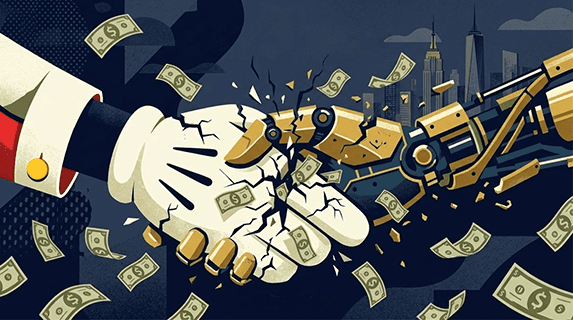
When OpenAI announced a licensing deal with Disney in December 2024, it felt like a turning point. Mickey Mouse, Darth Vader, Iron Man, over 200 beloved characters were coming to Sora. A $1 billion investment. A three-year agreement. Two giants promising a new era of AI storytelling.
Three months later, Sora app shutdown was a reality. The Disney OpenAI deal never closed. Not a dollar changed hands.
The collapse is one of the most revealing stories in AI yet, exposing the gap between AI press release vs product reality. It raises an uncomfortable question: was Sora ever truly a product, or just a research project in a consumer app's clothing?
The Deal That Never Was
The announcement had all the fanfare two names that big could generate. Bob Iger called it a way to "thoughtfully extend our storytelling through generative AI." Sam Altman called it proof that AI and creative industries could work together responsibly.
The AI IP licensing creative industry was under fire, unauthorized training data, deepfakes, displaced workers. A licensed deal with Disney, the most recognizable IP portfolio on earth, would have signaled that Sora had found a real path into mainstream entertainment.
Instead, it became a cautionary tale.
Reuters later reported no money ever changed hands. When OpenAI exited video generation in March 2025, Disney's statement was diplomatic but clear: it "respected OpenAI's decision to exit the video generation business." It pointedly left the door open for future partnerships with other platforms.
The Disney OpenAI deal collapse didn't fall apart over negotiations or a change of heart. It failed because the product underneath it was already in trouble, and no marquee AI licensing deal entertainment industry could fix that.
Death by a Thousand Burdens
The simplest explanation, that why did OpenAI cancel Sora comes down to compute, is true but incomplete. Yes, Reuters confirmed it was leaving other OpenAI teams under-resourced. But compute costs rarely kill a product that's generating real commercial value.
The deeper problem was that Sora had been asked to be too many things at once, and it was failing at all of them.
It was a frontier AI video model trying to compete in a market where Chinese rivals, Runway AI video, and Google Veo were gaining serious traction.
It was a short-form social app with community feeds, remixing tools, and content moderation at scale, notoriously expensive and reputationally risky.
It was an AI video rights management problem in one of tech's most legally contested spaces. OpenAI was forced to crack down on AI depictions of Michael Jackson, MLK, and Mister Rogers after protests from estates and actors' unions. CAA publicly warned Sora posed "significant risk" to creators, demanding answers on compensation and credit.
And it was a Sora deepfake controversy creators’ liability requiring constant policy enforcement.
None of these problems were individually fatal. Together, they made a product that was too expensive to run, too controversial to scale, and too unfocused to own any single market.
The 24-hour timeline says it all: OpenAI published a safety page on Monday, calling Sora "state-of-the-art video generation." By Tuesday, Sora app shutdown was confirmed. Even members of the Sora team reportedly never saw it coming.
AI Hype vs. AI Reality
Sora app shutdown explained isn't just a product failure story. It's a case study in how AI product announcement vs execution creates dangerous gaps between expectation and reality.
The product had been through multiple high-profile relaunches. Sora 2 arrived in September 2025, with OpenAI calling the original "the GPT-1 moment for video." A new editor launched days before the shutdown. "Sora for Business" was still listed on help pages as something users should "look forward to." Right up until the end, Sora was being dressed for a future it was never going to have.
This isn't unique to OpenAI. Announcing partnerships, publishing roadmaps, and positioning products as transformational, before the commercial and ethical foundations are stable, is a recurring pattern across the AI industry. And it has real costs for the studios, agencies, and creators who build plans around tools that may not survive the next product cycle.
Where AI Video Is Actually Heading
OpenAI has been clear: the research isn't going away. The Sora team is being redirected toward world simulation for robotics, arguably the higher-value application all along. Understanding physics, motion, and object permanence in video translates directly to training robotic systems that need to navigate the physical world.
For the creative industries, the practical question is where AI video goes from here. The market is already signaling an answer. Adobe and Runway are integrating AI video into professional production workflows. Canal+ is using Google's Veo 3 for scene pre-visualization. WPP launched a production studio built on NVIDIA Omniverse. In each case, AI video is being embedded into existing systems, not pushed as a standalone destination.
As for Disney, the door is open. Its exit statement carefully noted continued interest in AI platforms that respect IP and creators' rights. Runway, with its creator-friendly reputation, and Google's Veo, backed by YouTube and Google Cloud, are the most credible candidates to fill the space Sora left behind.
The Takeaway
Sora arrived as one of AI's most ambitious products, promising to simulate the physical world, democratize video creation, and bring Disney's storytelling legacy into an AI-powered future. It ended with a safety page on Monday and a shutdown notice on Tuesday, while a billion-dollar deal quietly evaporated in the background.
The lesson isn't that AI video is dead. The technology is real, and it's moving fast. The lesson is that AI press release vs product reality gaps can be enormous, and those who treat press releases as proof of product are the most exposed when that gap closes.
Build around systems. Not hype cycles.
Editor’s Note: OpenAI’s Sora 2, and all its subsequent versions, is no longer available for personal and commercial use. As of September 24, 2026, OpenAI (ChatGPT, Codex) has ceased all API support for its AI Video Generation Platform, Sora 2. This is following the closure of Sora 2’s app and website back on April 26, 2026.