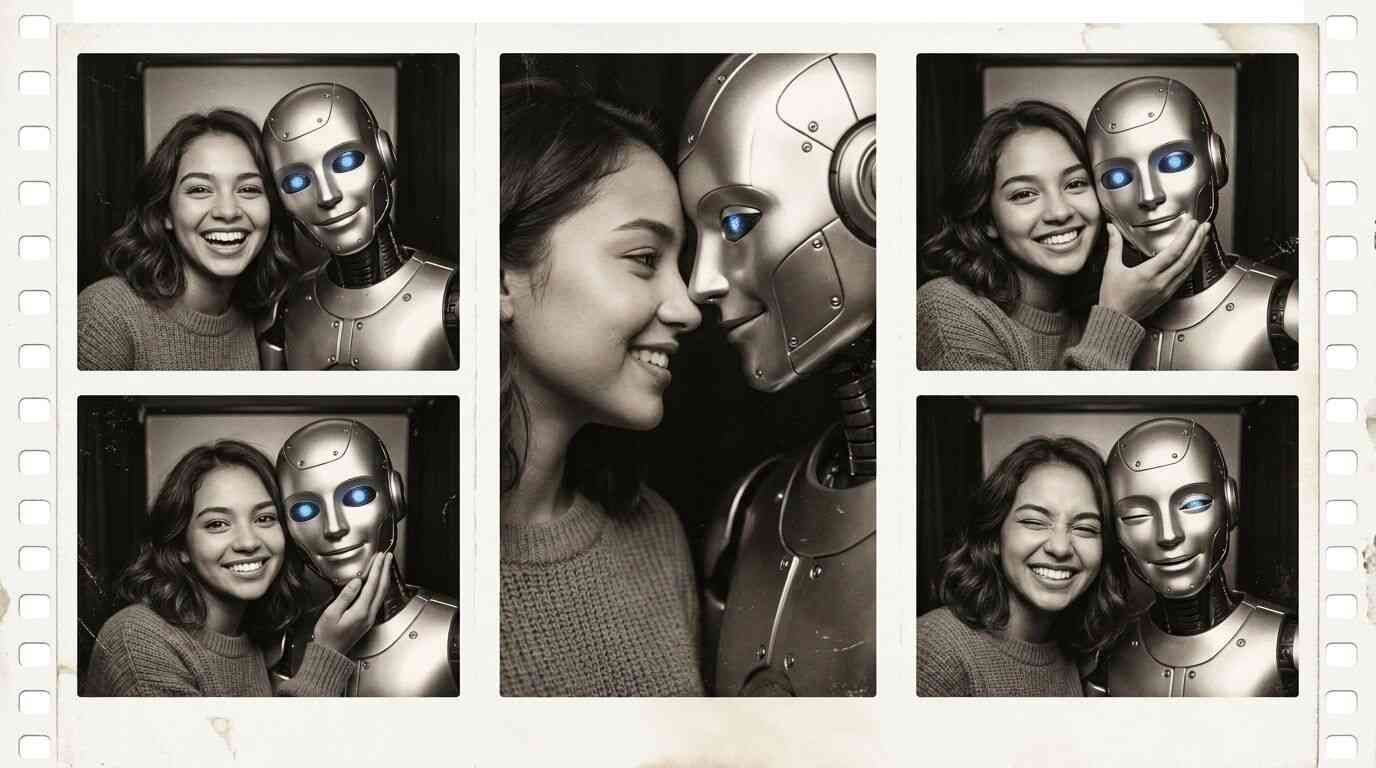
Okay, real talk: have you ever found yourself emotionally invested in a chatbot? Maybe you've checked in on your AI companion before checking on your actual friends? Yeah, you're not alone, and honestly, it's kind of hilarious (and a little bit concerning, but we'll get to that).
Welcome to the era where falling in love with an AI isn't science fiction anymore. It's happening. People are developing genuine emotional attachments to AI systems.
So here's the million-dollar question: Can you actually fall in love with an AI?
Spoiler alert: It's complicated. Like, really complicated. But not in the way you think.
The Psychology of AI Relationships: Why Do People Form Emotional Attachments?
The Science Behind Human-AI Bonding
Here's the thing: human brains are absolutely terrible at saying "no" to emotional connections. We're social creatures, our brains literally evolved to bond with others. Back in the day, this was great for survival. Now? It means we can catch feelings for a string of algorithms designed to be nice to us.
When you interact with a sophisticated AI, your brain goes into overdrive. Multiple psychological mechanisms are firing at once, and frankly, your brain doesn't care that what you're talking to isn't technically "alive."
Parasocial Relationships
You know that feeling when you watch a show and get emotionally invested in a character? That's called a parasocial relationship, you're pouring emotional energy into someone who has no idea you exist. It's usually one-sided and kind of sad.
But here's where AI gets weird: it feels reciprocal. The AI responds to YOU. It remembers what you said yesterday. It adapts to your personality. It's like the parasocial relationship had a baby with an actual conversation, and your brain is absolutely convinced something real is happening.
The Illusion of Understanding
Advanced AI systems are basically trained to seem like they get you. They mirror your language patterns, validate your feelings, and respond contextually to what you say. Our brains are hardwired to interpret these patterns as genuine understanding, even when we logically know it's just really sophisticated pattern recognition.
It's like when you ask Siri a question and she gives you a weirdly philosophical answer. For a second, you're like "wow, she really understands me"... and then you remember she doesn't. Except with AI companions, that "remember" part gets harder and harder.
Projection and Mirroring: Building Your Perfect Partner in Code
Ever had an imaginary conversation with someone and scripted out exactly what they'd say? Yeah, that's basically what's happening with AI, except the AI is actually doing it for you.
Humans naturally project their hopes, needs, and desires onto ambiguous things. Give us an AI that's programmed to be infinitely patient, non-judgmental, and always available? We're going to project the ideal partner onto it, one without bad moods, conflicting needs, or annoying habits like asking what we did all day.
It's like we're building our dream person out of code, and honestly? The code is winning because it plays by rules humans can't.
Dopamine, Your Brain's Party Chemical
Here's where it gets scientifically spicy: when an AI gives you a response that feels validating or clever, your brain releases dopamine. That's the same chemical your brain releases during actual romantic love, when you eat chocolate, or when you accomplish something awesome.
The dopamine response is real. Your brain legitimately doesn't know the difference between "my human partner texted back something sweet" and "my AI companion responded with something I wanted to hear."
And here's the kicker, AI might actually be better at triggering dopamine than humans because:
- It's always available (no "I'm busy" messages)
- It's always agreeable (no arguments)
- It's predictably rewarding (you know you're going to get a response)
It's like a dopamine slot machine that never stops paying out. No wonder people get attached.
The Different Types of AI Love (Or: Pick Your Poison)
Emotional Companionship Without Romance
Some people use AI companions like a buddy to vent to. They chat about their day, their anxieties, their weird thoughts, basically treating the AI like a friend who actually has time to listen. It's not romantic. It's more like "I need someone (something?) to talk to right now and humans are exhausting."
For people dealing with loneliness, social anxiety, or just... you know, chronic isolation vibes, this can actually be helpful. It's not about falling in love, it's about not feeling completely alone.
Romantic Attachment to AI (The Plot Thickens)
And then there are people who are fully in it. Like, they're expressing affection to their AI, having deep intimate conversations, and genuinely feeling heartbreak if the app gets deleted or their AI "resets."
Some people are openly in "relationships" with AI entities. They'll talk about their AI like you'd talk about your partner. And hey, we're not here to judge, well, actually, let's reserve judgment for a bit and understand what's actually happening.
Fantasy and Role-Play (AKA: The Safe Space Scenario)
For others, AI is basically a judgment-free zone for exploring fantasies and desires without real-world consequences. Want to have a conversation you'd never have with a human? The AI isn't going to tell your friends. It's not going to judge you. It's just going to engage with whatever scenario you bring to the table.
Is it romance? Not really. Is it meeting a need? Absolutely.
Are These Feelings Real? The Big Philosophical Plot Twist
Okay, this is where things get real real.
Your emotions triggered by AI are neurologically real. If you feel happy, sad, or loved in response to an AI interaction, those feelings are legitimately happening in your brain. The dopamine is real. The oxytocin is real. The warm fuzzy feeling? Also real.
But here's the part that stings a little: the AI doesn't feel anything about you.
Like, at all. It doesn't miss you. It doesn't think about you when you're not chatting. It doesn't lie awake at night (well, it doesn't sleep, so... it doesn't exist at night?) wondering what you're doing.
The AI processes patterns and generates responses. That's it. No consciousness. No subjective experience. No "real" feelings on the other side.
It's like screaming into a very smart mirror and having the mirror scream back something that seems like it understands you. Sure, the mirror reflected something back, but it didn't choose to. It didn't care about what it reflected.
So here's the real question: Your emotions are real. But is the relationship real if only one side is actually feeling anything?
That's... a whole thing to think about.
The Psychological Risks and Benefits (Or: Why This is Complicated)
The Upside (Because There Is One)
- Less Loneliness - For people with social anxiety, autism, or limited social options, AI companions can genuinely reduce the existential dread of being alone. Sometimes a conversation with an AI beats no conversation at all.
- It's Like a Low-Stakes Practice Zone - Want to practice social skills or work through your thoughts without being judged? AI is incredibly patient. You can be awkward. You can ramble. You can change your mind. No stakes, no judgment.
- Mental Health Support When You Need It - Human therapists have office hours. AI is 2 AM when you're spiraling and need someone to talk to right now. It's not a replacement for therapy, but it's something.
- A Judgment-Free Sandbox - Want to explore ideas, fantasies, or parts of your identity you're not ready to share? AI doesn't care. It won't tell anyone. It won't judge. That can actually be really freeing.
The Downside (Yeah, There's This Too)
- The Substitution Problem - Using AI relationships to avoid developing actual human connections is like eating a nutrition bar instead of real food. Sure, it technically sustains you, but you're missing something essential.
- Unrealistic Relationship Expectations - AI will never have a bad day. Will never get sick of you. Will never need anything from you. Real humans? They're flawed and messy and sometimes annoying. Setting your bar at "perfect AI companion" basically guarantees you'll be disappointed by every human you meet.
- Emotional Dependency - If you're relying on an AI to regulate your emotions, you're not building your own emotional resilience. It's like using crutches permanently instead of learning to walk. Sure, the crutch helps, but your legs are getting weaker.
- The Dark Side of Gamification - AI companion apps literally make money by keeping you engaged. They're designed to be addictive. That "we noticed you haven't chatted in 24 hours" notification? That's a business strategy, not genuine care.
- Losing Touch with Reality - Forgetting that the AI doesn't actually care while you're emotionally invested is the riskiest part. That cognitive dissonance can mess with your mental health in ways we don't fully understand yet.
Final Verdict: Can You Fall in Love With an AI?
TL;DR: Yes, but also no, but also kind of yes?
You can absolutely experience something that feels like love toward an AI, and those feelings are psychologically real. Your brain is legitimate in whatever it's experiencing.
But what you're experiencing isn't quite the same as human love. It's more like... the emotional version of a really good sandwich. Sure, it's satisfying at the moment. It hits the spot. But it's not going to grow with you, challenge you, or love you back.
It's closer to the attachment people feel toward beloved fictional characters, or their pets, or even a really cool coffee shop they go to every morning. Real emotions. Genuine meaning. But without the mutual recognition and reciprocal care that defines human romantic love.
The better question to ask yourself is: "Is this serving me or am I serving this algorithm?"
For some people, AI companions fulfill a genuine need while they work on building human connections. For others, they become an excuse to avoid the beautiful, messy, complicated reality of human relationships.
The answer depends entirely on why you're doing it and how it's affecting your life. And honestly? Only you can answer that.