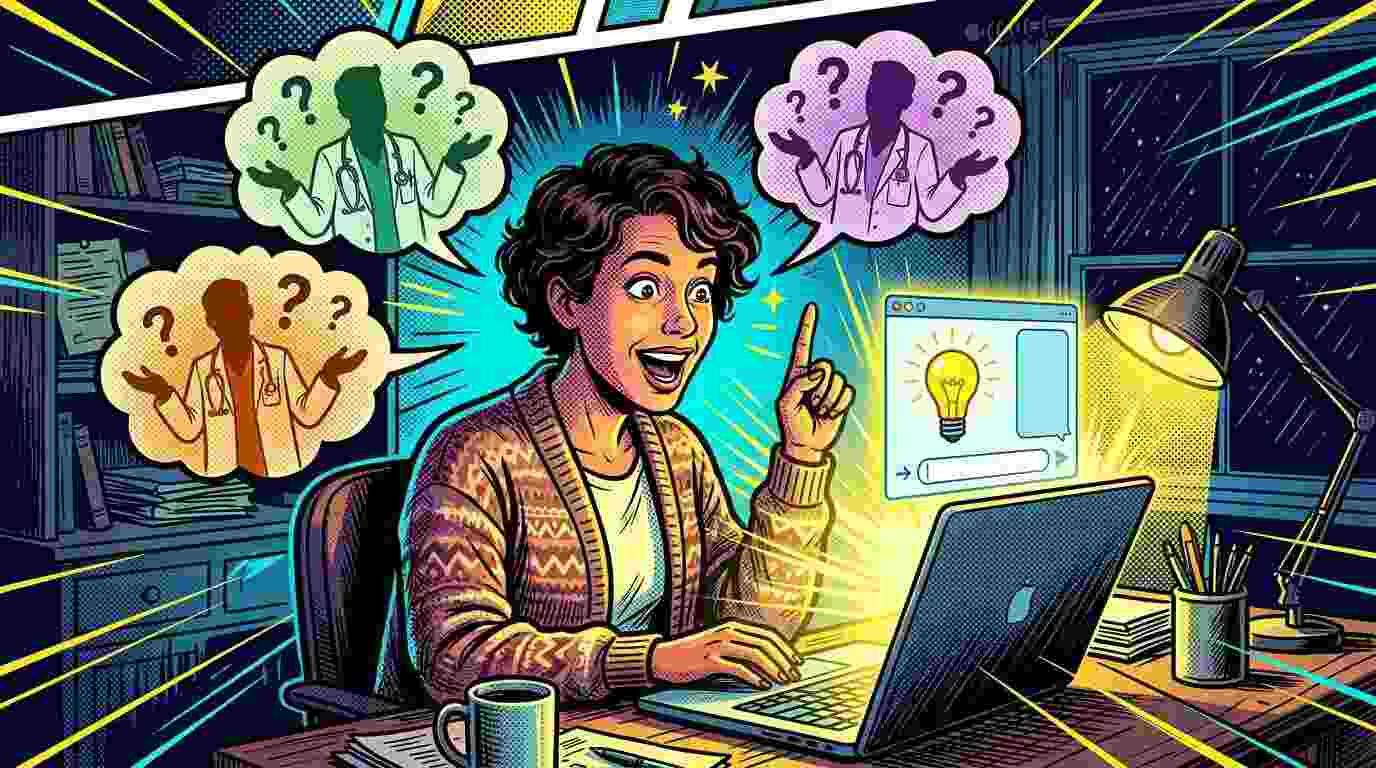
Not a Hospital. Not a Specialist. A Mom on Her Laptop at Midnight.
In 2020, a young boy named Alex started showing strange symptoms.
Chronic pain. Difficulty sitting cross-legged. Chewing on things he shouldn't. Struggling to keep up with other kids.
His parents knew something was wrong.
What followed was three years and 17 doctors: pediatricians, dentists, neurologists, spinal MRIs, CT scans, and screenings for Lyme disease and multiple sclerosis.
Nothing. No diagnosis. No answers.
Then, in 2023, his mother Courtney made an account on ChatGPT.
One Night. One AI. One Answer.
Courtney spent an entire evening going line by line through Alex's MRI reports, symptom history, and doctor's notes, feeding three years of accumulated data into the AI.
"I went line by line of everything that was in his MRI notes and plugged it into ChatGPT," she later told NBC's Today show. "I put the note in there about how he wouldn't sit crisscross applesauce. To me, that was a huge trigger that a structural thing could be wrong."
ChatGPT returned a diagnosis not one of the 17 specialists had ever suggested: tethered cord syndrome, a neurological condition where the spinal cord is abnormally attached to surrounding tissue, causing pain, weakness, and developmental issues.
Courtney found a Facebook group for families of children with the condition. Their stories sounded exactly like Alex's. She scheduled an appointment with a new neurosurgeon, walked in with her hypothesis, and the neurosurgeon confirmed it on the spot: spina bifida occulta and an associated tethered spinal cord.
Within five weeks of that conversation with an AI, Alex was in surgery.
Why Did 17 Doctors Miss It?
This is not a story about incompetent doctors. Every specialist Alex saw was qualified. The problem is that medicine is built on specialization. No one is responsible for stepping back and seeing the whole picture.
Courtney had spent months assembling a 34-month symptom journey, charts, portal data, timeline notes. As she wrote: "As so many doctors told me, they didn't have time to read his binder."
ChatGPT had no time pressure. No billing constraints. No specialty silo. It read everything at once, and pointed to the condition that made all of it make sense.
From One Family's Story to a Harvard Study
Courtney's story went viral in September 2023. By late 2024, she was featured on NEJM AI Grand Rounds alongside Dr. Holly Gilmer, the pediatric neurosurgeon who confirmed and treated Alex.
Science has since caught up. In April 2026, a landmark study in Science by Harvard Medical School and Beth Israel Deaconess Medical Center found that OpenAI's o1 model outperformed experienced physicians in ER diagnostic accuracy:
- AI correctly identified the right diagnosis in 67% of triage cases
- Human physicians scored 55% and 50% under identical conditions
- In every single experiment across six tests, the AI outperformed the doctors
On management reasoning, test ordering, antibiotic recommendations, end-of-life decisions, the AI scored 89%. Doctors using Google scored just 34%.
What This Means for You
Millions of people navigate complex health situations with no one owning the full picture, carrying information from appointment to appointment, assembling binders, and hoping someone reads them.
AI does not fix the healthcare system. If something feels wrong, it is always best to consult a doctor or visit the ER immediately.
But AI does something remarkable.
It reads the binder.
And this ability, to synthesize complex information, connect patterns across disparate sources, and surface insights no single expert might catch, is not limited to medicine. It applies to every domain where information is fragmented and the full picture matters.